World Representation
Is there a universally optimal world representation for robot policy learning, or is representation effectiveness fundamentally coupled with the integration paradigm?
A systematic, controlled empirical investigation of world modeling in VLA policies across diverse world representations, four representative integration paradigms, distinct policy backbones, and diverse task conditions.
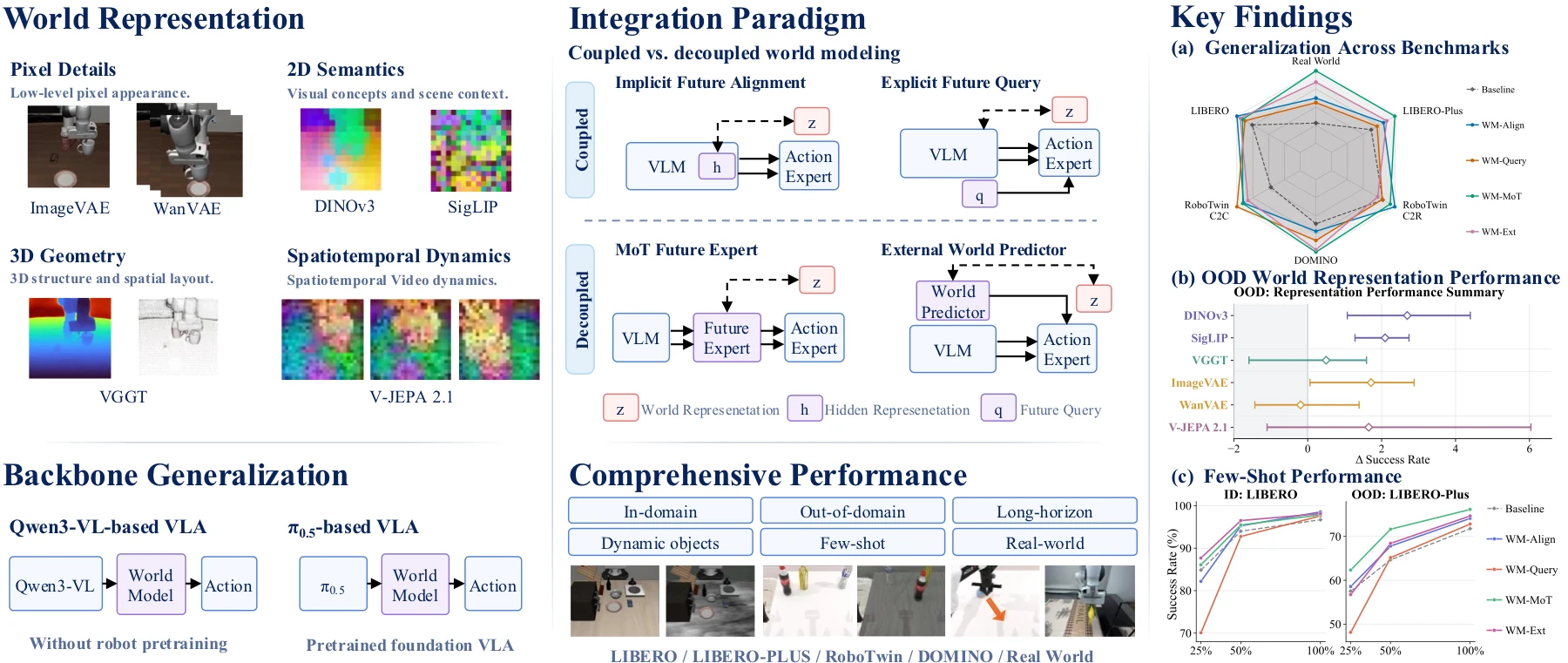
Standard VLAs mainly predict actions from the current observation. World models enable policies to anticipate future world dynamics.
Existing approaches vary simultaneously in their world representations, integration paradigms, and policy backbones, making it difficult to determine what truly matters for effective world model integration.
Is there a universally optimal world representation for robot policy learning, or is representation effectiveness fundamentally coupled with the integration paradigm?
What are the performance trade-offs among different integration paradigms, and is coupled or decoupled world modeling more effective?
Do world modeling integration paradigms remain effective across policy backbones, spanning models without robot pretraining and pretrained foundation VLAs?
How do different world modeling integration paradigms perform under diverse task conditions?
The following foresight strategies share this unified baseline, differing in how they integrate world modeling into action generation.
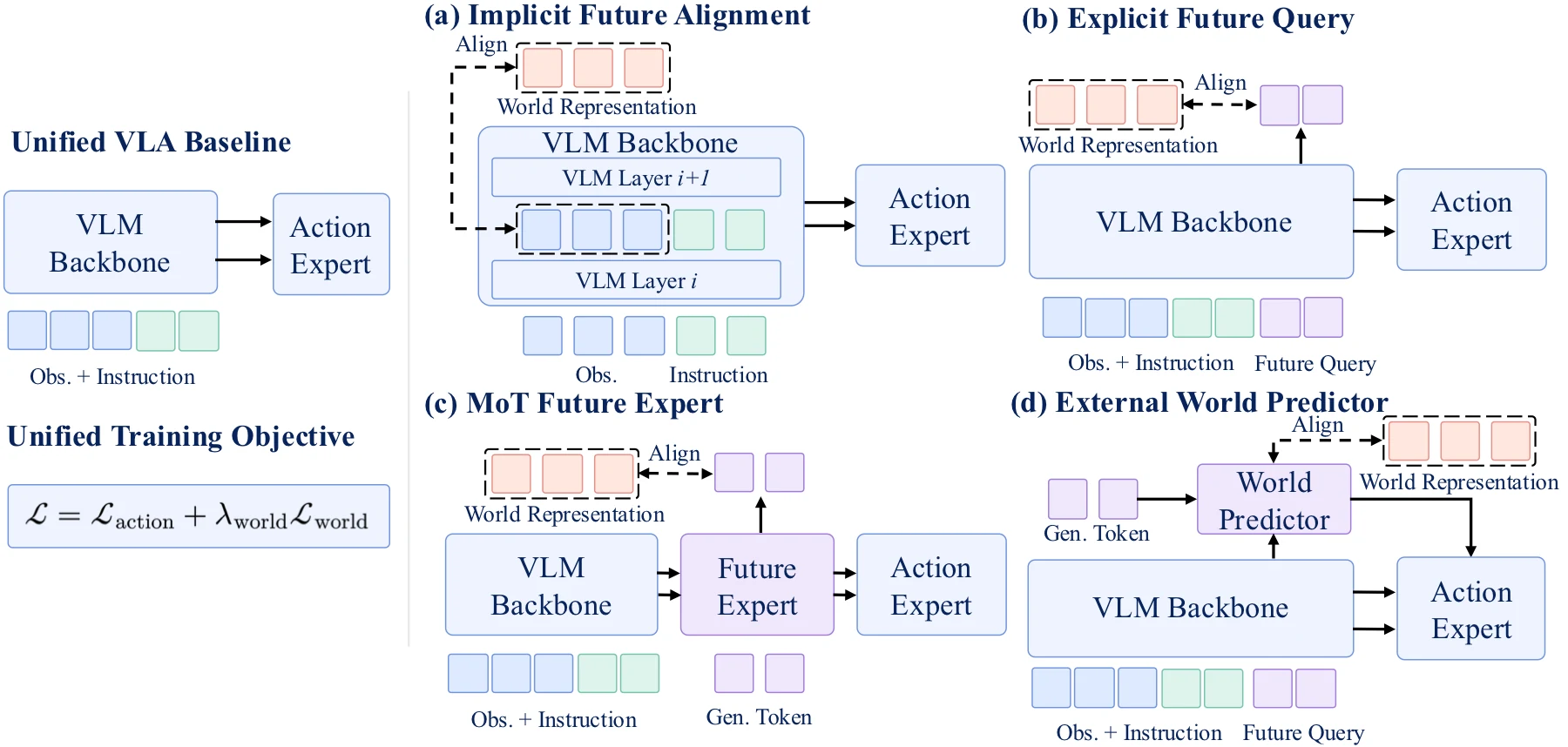
Implicit Future Alignment
Supervises the VLM's visual representations to capture predictive world dynamics. At inference, the auxiliary predictor is discarded, leaving policy deployment identical to the baseline.
Explicit Future Query
Uses learnable future query tokens to aggregate task-relevant multimodal context into compact predictive representations that explicitly augment the action expert's context.
MoT Future Expert
Uses a dedicated Future Expert as a parallel MoT stream. The Action Expert interacts with both the VLM and Future Expert across all intermediate layers.
External World Predictor
Decouples world modeling into a standalone module and explicitly conditions action generation on the final predicted world representation.
Four future observations at offsets {4, 8, 12, 16} provide identical temporal supervision across all strategies.
The decoupled MoT Future Expert offers competitive overall performance, particularly in OOD robustness.
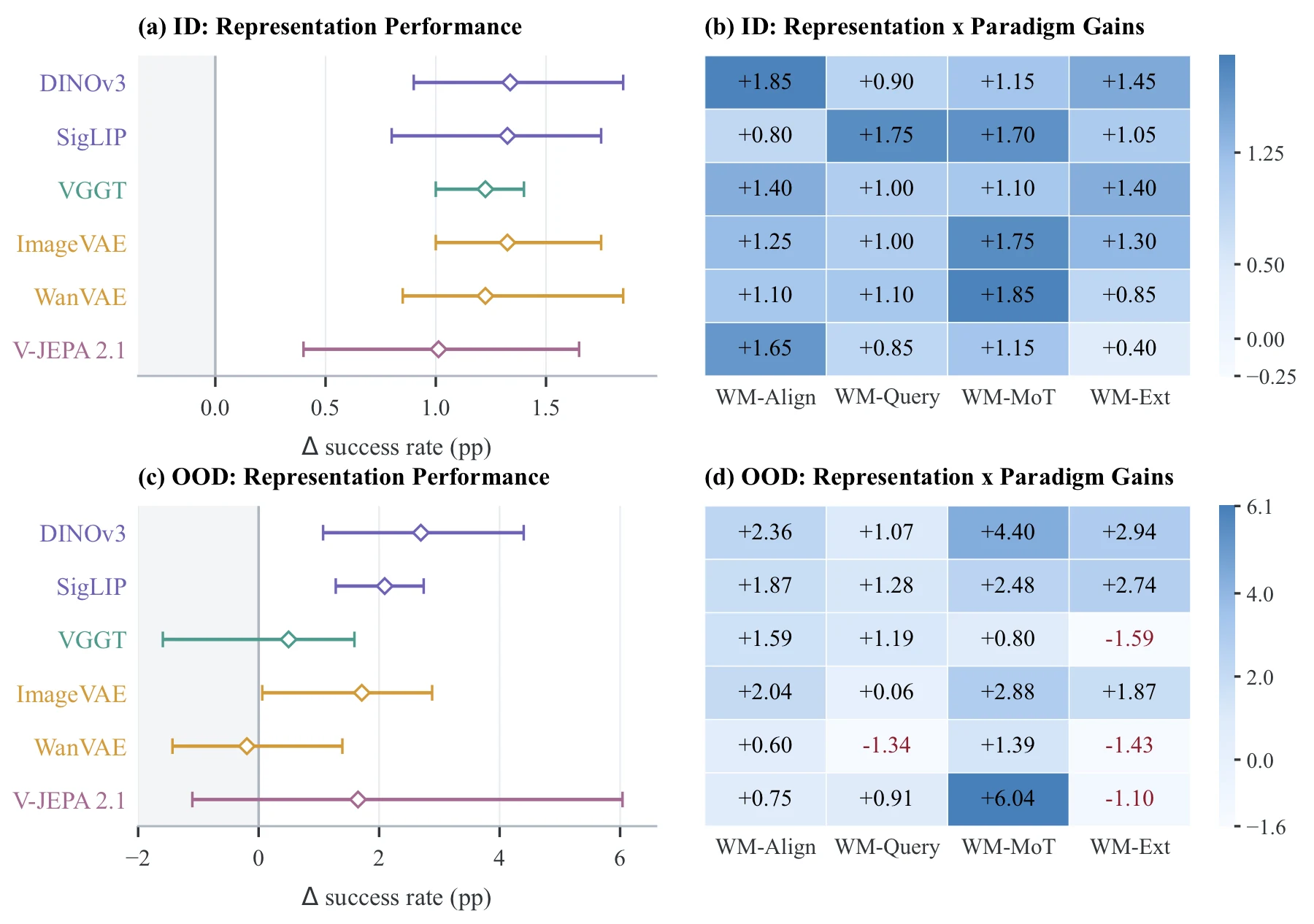
No single world representation universally dominates across architectures; instead, their relative rankings reverse across paradigms.
Finding 2: 2D semantic representations offer robust, cross-paradigm gains. DINOv3 and SigLIP consistently improve both ID and OOD averages across all four paradigms.
WM-MoT provides the largest overall boost and improves across all seven categories.
Improvements progressively increase with horizon length under Clean2Clean.
WM-Ext and WM-MoT reach 15.1% and 15.5% success, respectively.
Average success rises from 45.0% to 56.3–73.8% across the four paradigms.
Success rates (%). Green and red deltas indicate changes from the corresponding action-only baseline.
Performance across world modeling paradigms.
| Method | LIBERO | LIBERO-Plus | |||||||
|---|---|---|---|---|---|---|---|---|---|
| Camera | Robot | Language | Light | Background | Noise | Layout | Avg. | ||
| OpenVLA-OFT | 97.1 | 56.4 | 31.9 | 79.5 | 88.7 | 93.3 | 75.8 | 74.2 | 69.6 |
| Fast-WAM | 97.6 | 18.8 | 45.7 | 70.1 | 83.2 | 45.7 | 29.8 | 62.7 | 49.1 |
| 4D-WAM | 98.6 | 45.2 | 64.3 | 90.6 | 94.3 | 57.7 | 69.1 | 79.2 | 71.0 |
| Baseline | 96.7 | 48.2 | 51.4 | 91.4 | 96.0 | 92.9 | 65.3 | 71.3 | 71.8 |
| WM-Align | 98.6 +1.9 | 58.0 +9.8 | 49.7 −1.7 | 89.5 −1.9 | 94.6 −1.4 | 93.5 +0.6 | 71.8 +6.5 | 73.9 +2.6 | 74.1 +2.3 |
| WM-Query | 97.6 +0.9 | 54.4 +6.2 | 50.6 −0.8 | 88.5 −2.9 | 95.1 −0.9 | 96.3 +3.4 | 69.5 +4.2 | 69.5 −1.8 | 72.9 +1.1 |
| WM-MoT | 97.9 +1.2 | 59.7 +11.5 | 53.5 +2.1 | 91.6 +0.2 | 97.6 +1.6 | 95.9 +3.0 | 72.3 +7.0 | 75.2 +3.9 | 76.2 +4.4 |
| WM-Ext | 98.2 +1.5 | 55.7 +7.5 | 46.8 −4.6 | 91.2 −0.2 | 96.8 +0.8 | 95.5 +2.6 | 74.2 +8.9 | 75.9 +4.6 | 74.7 +2.9 |
Performance under Clean2Clean and Clean2Random evaluation.
| Method | Clean2Clean | Clean2Random | ||||||
|---|---|---|---|---|---|---|---|---|
| Short | Medium | Long | Avg. | Short | Medium | Long | Avg. | |
| starVLA | 49.7 | 51.9 | 28.8 | 46.5 | 4.0 | 3.2 | 0.6 | 3.2 |
| AHA-WAM | 60.3 | 76.7 | 59.1 | 64.3 | 2.6 | 5.8 | 1.2 | 3.2 |
| GalaxeaVLA | 63.0 | 71.6 | 48.9 | 62.7 | 11.5 | 19.6 | 6.7 | 12.7 |
| Baseline | 53.4 | 65.0 | 30.7 | 52.3 | 13.4 | 15.4 | 6.6 | 12.7 |
| WM-Align | 62.0 +8.6 | 72.4 +7.4 | 48.8 +18.1 | 62.3 +10.0 | 15.3 +1.9 | 17.9 +2.5 | 8.9 +2.3 | 14.8 +2.1 |
| WM-Query | 61.1 +7.7 | 77.8 +12.8 | 57.0 +26.3 | 64.7 +12.4 | 11.9 −1.5 | 15.8 +0.4 | 10.3 +3.7 | 12.6 −0.1 |
| WM-MoT | 60.3 +6.9 | 74.1 +9.1 | 52.9 +22.2 | 62.6 +10.3 | 12.6 −0.8 | 20.1 +4.7 | 9.8 +3.2 | 14.0 +1.3 |
| WM-Ext | 58.9 +5.5 | 73.8 +8.8 | 47.2 +16.5 | 60.7 +8.4 | 10.9 −2.5 | 16.4 +1.0 | 7.9 +1.3 | 11.8 −0.9 |
Performance on dynamic manipulation.
| Method | SR | MS |
|---|---|---|
| InternVLA-M1 | 5.4 | 27.6 |
| Isaac-GR00T | 6.1 | 28.6 |
| OpenVLA-OFT | 9.1 | 24.1 |
| π0.5 | 9.6 | 26.2 |
| Baseline | 10.6 | 29.1 |
| WM-Align | 11.9 +1.3 | 30.1 +1.0 |
| WM-Query | 13.5 +2.9 | 32.0 +2.9 |
| WM-MoT | 15.5 +4.9 | 32.9 +3.8 |
| WM-Ext | 15.1 +4.5 | 33.0 +3.9 |
Performance under Clean2Clean and Clean2Random evaluation.
| Method | Clean2Clean | Clean2Random | ||||||
|---|---|---|---|---|---|---|---|---|
| Short | Medium | Long | Avg. | Short | Medium | Long | Avg. | |
| π0.5 | 67.9 | 72.5 | 68.2 | 69.1 | 45.6 | 53.3 | 39.0 | 46.4 |
| + WM-Align | 64.1 −3.8 | 66.8 −5.7 | 57.6 −10.6 | 63.6 −5.5 | 39.9 −5.7 | 47.2 −6.1 | 35.9 −3.1 | 41.0 −5.4 |
| + WM-Query | 67.8 −0.1 | 72.4 −0.1 | 66.0 −2.2 | 68.7 −0.4 | 45.4 −0.2 | 50.7 −2.6 | 42.3 +3.3 | 46.2 −0.2 |
| + WM-MoT | 69.6 +1.7 | 76.8 +4.3 | 68.6 +0.4 | 71.3 +2.2 | 49.6 +4.0 | 51.5 −1.8 | 47.2 +8.2 | 49.7 +3.3 |
| + WM-Ext | 71.5 +3.6 | 74.9 +2.4 | 67.9 −0.3 | 71.7 +2.6 | 48.1 +2.5 | 52.4 −0.9 | 44.1 +5.1 | 48.5 +2.1 |
Dedicated predictive modules can more flexibly capture continuous object motion than shared token-wise alignment or bottleneck queries.
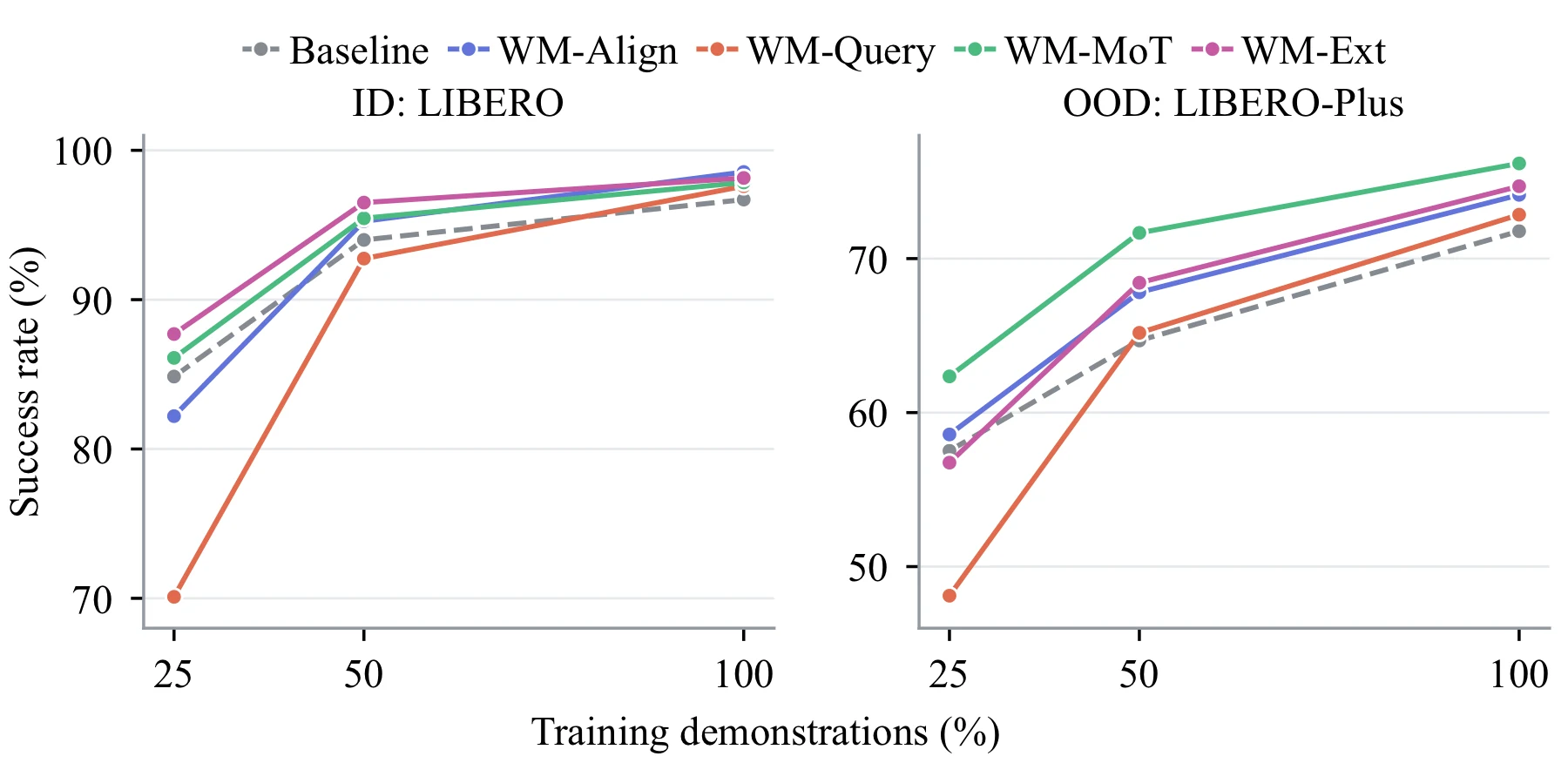
Finding 6: Decoupled paradigms retain stronger performance under data scarcity. WM-Ext achieves the highest in-domain sample efficiency, while WM-MoT provides the strongest out-of-distribution robustness.
Decoupled architectures transfer more favorably to the pretrained backbone. In contrast, WM-Align imposes auxiliary predictive objectives directly onto the shared visual representations, which can distort the pretrained feature space and disrupt the manipulation priors established during pretraining.
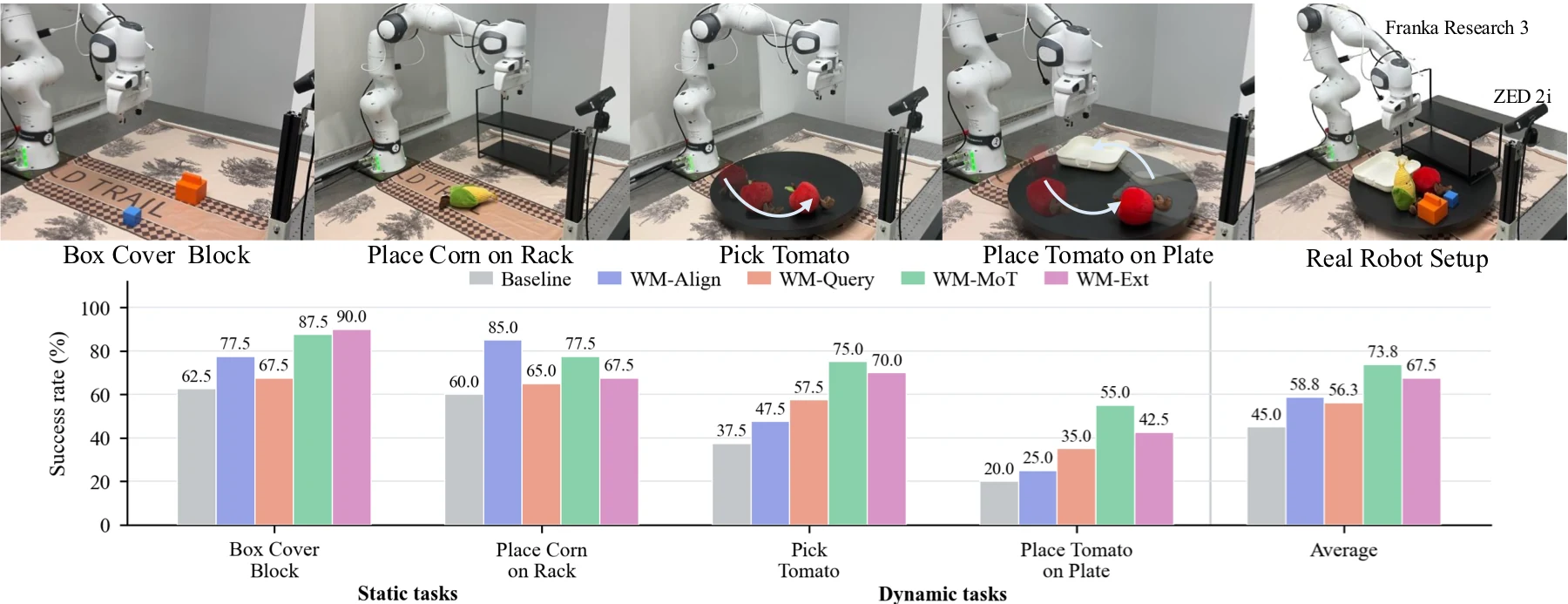
Physical Franka Research 3; 40 trials per method and task.
| Method | Static tasks | Dynamic tasks | Overall | ||||
|---|---|---|---|---|---|---|---|
| Box cover | Corn rack | Avg. | Pick tomato | Tomato plate | Avg. | ||
| Baseline | 62.5 | 60.0 | 61.3 | 37.5 | 20.0 | 28.8 | 45.0 |
| WM-Align | 77.5 | 85.0 | 81.3 | 47.5 | 25.0 | 36.3 | 58.8 |
| WM-Query | 67.5 | 65.0 | 66.3 | 57.5 | 35.0 | 46.3 | 56.3 |
| WM-MoT | 87.5 | 77.5 | 82.5 | 75.0 | 55.0 | 65.0 | 73.8 |
| WM-Ext | 90.0 | 67.5 | 78.8 | 70.0 | 42.5 | 56.3 | 67.5 |
2D semantic representations provide reliable gains across paradigms, whereas pixel and 3D representations are more sensitive to integration architectures.
Coupled designs offer compact representations for static manipulation, while decoupled architectures provide superior robustness under distribution shifts and dynamic manipulation.
Decoupled integration shows better compatibility when adapting pretrained foundation VLAs.
Representative physical-robot rollouts for the action-only baseline and four world modeling paradigms.
Each task is shown in the fixed order: Baseline, WM-Align, WM-Query, WM-MoT, and WM-Ext.